The Charity Commission is today providing an update on its work in relation to charities demonstrating and reporting on the benefit they bring to the public, as set out in the Charities Act 2006.
The update relates to two areas of work: the publication today of four assessments of arts charities; and completion of the work in connection to assessments into the public benefit of 12 charities conducted in 2009, including charities advancing religion, independent charitable schools and charitable care homes.
The purpose of conducting assessments into the public benefit of a selection of charities is to provide real examples for the rest of the charity sector, to help in their awareness and understanding of public benefit, alongside the published guidance the Commission has already published.
Research by FDS International shows that three quarters (76%) of charity trustees say that they know about the public benefit requirement and nearly a quarter of trustees (22%) who are aware of the requirement say their charity has revisited its aims as a result.
On arts charities, four reports into the public benefit of arts charities are published. The charities are:
· The Royal Opera House Covent Garden
· The Young Concert Artists Trust
· The Castle Players
· Gwent Ballet Theatre, known as the Independent Ballet Wales
The Commission found that all four charities that were assessed are being administered for public benefit.
The full reports for the four charities can be found on the Commission’s website.
The assessments help to demonstrate that the public benefit principles are flexible enough to apply to four very different arts charities in terms of profile, size and operation, yet clear enough to distinguish them from organisations which are not charities.
The report then looks at independent charitable schools and charitable care homes.
In July 2009, the Commission found that eight of the twelve charities assessed, including charities advancing religion, independent charitable schools and charitable care homes, were being administered for public benefit, and four were not.
These were made up of two care homes and two independent schools. The four charities agreed to work on plans for how they intended to address the concerns raised.
All four charities have developed and submitted plans, each of which reflects the circumstances of the charity and the flexibility of approach available to charities in demonstrating public benefit.
Summaries of these plans are published on the Commissions’ website today.
All the charities have been given sufficient time to implement those plans, with up to five years where necessary.
The plans for the two schools (S. Anselm’s School Trust Limited and Highfield Priory School Limited, used a mix of new or additional bursary assistance financed by fundraising, together with the educational benefits they provide in the local community.
Neither school plans to increase its fees as part of these changes.
The Commission took into account the totality of benefits provided, including work with local communities and state schools as well as bursaries.
It concluded that these charities had addressed the findings of the Commission’s public benefit assessments published in July 2009 and that the trustees are carrying out their duty to administer the two charities for public benefit.
The Commission has also agreed that the trustees of Penylan House, Jewish Retirement and Nursing Home have addressed the original findings by developing a clear strategy for providing and publicising the assistance it offers to those who could not otherwise afford to use its services.
The fourth charity, The Rest Bay Convalescent Hotel, faced some significant challenges and is continuing to work on its plan, having been given a four month extension to complete it.
Dame Suzi Leather, chair of the Charity Commission, said: “Charities play a vital role in society, and showing how they benefit the public is an essential part of that. We have consistently said that most charities can demonstrate sufficiently how they benefit the public, and the arts charities, schools and care homes we have worked with have proved this.
"All the charities took a constructive and imaginative approach and I particularly want to recognise their hard work and goodwill.
“The arts charities have shown how they are accessible to a wide range of people, which confirms their uniqueness as charities. The plans that the schools and care homes have put in place underline very clearly that we take into account all the ways in which charities can fulfil their aims for the public benefit. We have every reason to be confident in their commitment to putting these plans into place.”
The Charity Commission now plans to review a small number of sports and recreation charities.
This will complete its programme of public benefit assessments.
The summary plans and reports are available here


Latest News
-
British Heart Foundation to close almost one in four of its charity shops
-
Jobs at risk as RSPB looks to cut operating costs by 7%
-
Monday movers - 8 June
-
‘Lack of buy in’ from charity leaders hindering philanthropy, fundraising body warns
-
World’s wealthiest continue to be less generous than those in lower income countries
-
Seven in ten new regular donors recruited through face-to-face fundraising, survey finds




Charity Times video Q&A: In conversation with Hilda Hayo, CEO of Dementia UK
Charity Times editor, Lauren Weymouth, is joined by Dementia UK CEO, Hilda Hayo to discuss why the charity receives such high workplace satisfaction results, what a positive working culture looks like and the importance of lived experience among staff. The pair talk about challenges facing the charity, the impact felt by the pandemic and how it's striving to overcome obstacles and continue to be a highly impactful organisation for anybody affected by dementia.
Charity Times Awards 2023
Mitigating risk and reducing claims
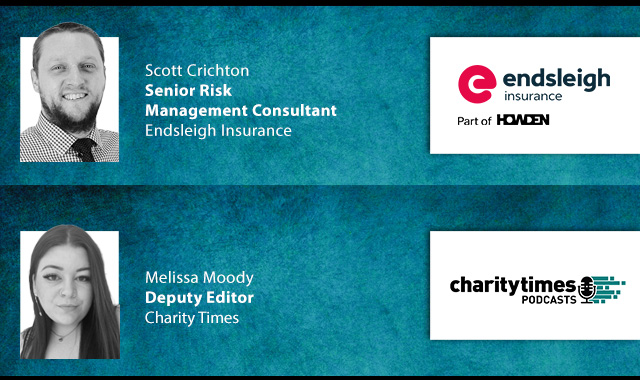
The cost-of-living crisis is impacting charities in a number of ways, including the risks they take. Endsleigh Insurance’s* senior risk management consultant Scott Crichton joins Charity Times to discuss the ramifications of prioritising certain types of risk over others, the financial implications risk can have if not managed properly, and tips for charities to help manage those risks.
* Coming soon… Howden, the new name for Endsleigh.
* Coming soon… Howden, the new name for Endsleigh.
Better Society




© 2021 Perspective Publishing Privacy & Cookies
Recent Stories